
Smell Again: Olfactory Rehabilitation Using an Essential Oils Multi-Path Sensory Method
You don’t think about your sense of smell.
Until it’s gone.
Then everything shifts.
Key Takeways
The Backup System: When the olfactory nerve fails, the trigeminal nerve (sensing cooling, warmth, tingling) and nasal airflow (brain rhythm priming) remain intact.
Complex vs. Synthetic: Natural essential oils activate broader receptor networks and trigger physical sensations (e.g., peppermint for cooling) that bypass smell loss.
Top-Down Memory: Familiar scents activate brain memory circuits from above, helping rebuild the sensory network.
The Clinical Shift: Changing the question from "What do you smell?" to "What do you feel?" unlocks hidden, active neurological data.

Anosmia: The Loss of Smell
For many people, the impact of losing the sense of smell is far greater than expected. Emotion destabilizes. Food loses meaning. A sense of safety can change. Memory loses one of its most powerful triggers. Anosmia touches almost every dimension of daily life, quietly and completely.
The causes range from upper respiratory infection to head trauma to neurological disease. Since 2020, post-COVID anosmia brought smell loss into mainstream conversation at a scale the field had never seen. Millions of people are still waiting for it to return.
The standard medical response is olfactory training twice-daily exposure to four synthetic odorants for twelve weeks or more. It works. Within limits. What it misses is how much of the system is still available. The olfactory system has more pathways available during rehabilitation than standard training ever reaches. This article is about those pathways, and about why essential oils are the right tool for working with them.
What follows is a clinical hypothesis grounded in published neuroscience. The science is real. The application is immediate.
The Multi-Pathway Model
When someone inhales through the nose, something more complex than scent detection is already underway. Two chemosensory nerve systems are active simultaneously. The olfactory nerve carries scent identification signals toward the brain. The trigeminal nerve, running alongside it through an entirely separate anatomical pathway, carries chemosensory, thermal, and sensation signals. You recognize this through the cooling, tingling or warming senation. These are independent systems. They don’t fail together. When the olfactory nerve is damaged, trigeminal sensitivity is often still intact.
At the same time, the breath itself is organizing the neural environment. Before any scent registers, nasal airflow generates rhythmic electrical activity in the olfactory bulb and synchronizes the piriform cortex, amygdala, and hippocampus. The breath is doing neurological work. The scent arrives into a system already in motion.
The breath is the first therapeutic act. The scent comes second.
Standard training works with one pathway and leaves the rest untouched. A multi-path approach works with all of them at once because that’s how the olfactory system actually functions.
Essential Oils and the Multi-Pathway Response
Certain volatile compounds in essential oils bind to TRP channels expressed in the trigeminal nerve fibers of the nasal passage. Menthol produces cooling. Eugenol produces warmth. Cinnamaldehyde produces a sharp, pungent edge. This happens at the receptor level whether or not the olfactory nerve is delivering a full signal.
A whole essential oil brings something a single synthetic odorant cannot. In nature, scents arrive as complex mixtures, and the olfactory system evolved in response to that complexity. Each molecule in a complex oil competes for and activates different receptor binding sites. The engagement is broader and more aligned with how the system receives scent.

The familiar oil opens a door that the novel odorant cannot find.
Add to this a familiar oil, one with personal or cultural history, and another pathway opens. The brain can activate its memory of a scent before the peripheral signal is complete. The circuit fires from above through memory while sensation arrives from below. Two independent routes to the same network, working at the same time.
This is why oil selection matters. The oil that activates sensation. The oil that carries memory. The oil whose complexity engages the receptor system. These are clinical decisions.
The familiar oil opens a door that the novel odorant cannot find.
A Different Question Changes Everything
Standard olfactory assessment asks one question. What do you smell?
For someone with anosmia, that question confirms what they already fear. The damaged pathway is the one being tested. The answer is silence.
Ask instead: what do you feel?
There is another layer here.
The way a question is asked changes the response. Work in cognitive neuroscience has shown that suggestion and expectation can alter perception itself. The brain does not wait passively for input. It organizes what it expects to experience. In olfaction, this means the language around the experience can shape what comes forward. The shift from “what do you smell” to “what do you feel” is not just a different question. It changes the pathway being accessed [Raz et al., 2017; Landry et al., 2021].
That shift opens a different reporting channel. A person may report cooling, warmth, a change in breath, a memory without a scent attached, or a shift in tone. Every one of these responses reflects biological activity through pathways that are still working.
The question becomes both assessment and mechanism at once.
Working With It
When you use this approach, the focus shifts. You are no longer testing the system. You are reading how it responds. The shift is in how you recognize them and how you choose to engage them.
Start with the breath. Slow nasal breathing changes the condition of the system before any oil is introduced. The circuit is already activating.
Choose oils with the full picture in mind. For sensation, use oils with trigeminal activity peppermint, eucalyptus, clove, cinnamon. For memory, use oils with personal or cultural relevance. These are not just preferences. They are pathways.
Administer through slow nasal inhalation. The breath sustains the priming while the oil enters a system already in motion.
Then shift the question. Not just “what do you smell,” but “what do you feel.” That change alone opens access to responses that would otherwise be missed.
If you are working with someone who says they can’t smell anything, that does not mean nothing is happening. Bring attention to the breath. Ask about sensation cooling, warmth, movement. Ask about familiarity does anything feel known, even without a scent attached. These are active signals. They give you a place to work from.
The same applies when working on your own. The absence of scent does not mean the absence of response. The system is still communicating. The question is whether you are reading it.
The multi-path method is a protocol that becomes a working system and lifestyle practice. Breath, sensation, memory, and attention are not separate tools. They are part of the same event.
When you work this way, the focus shifts. You are no longer testing whether the system works. You are working with how it is working.
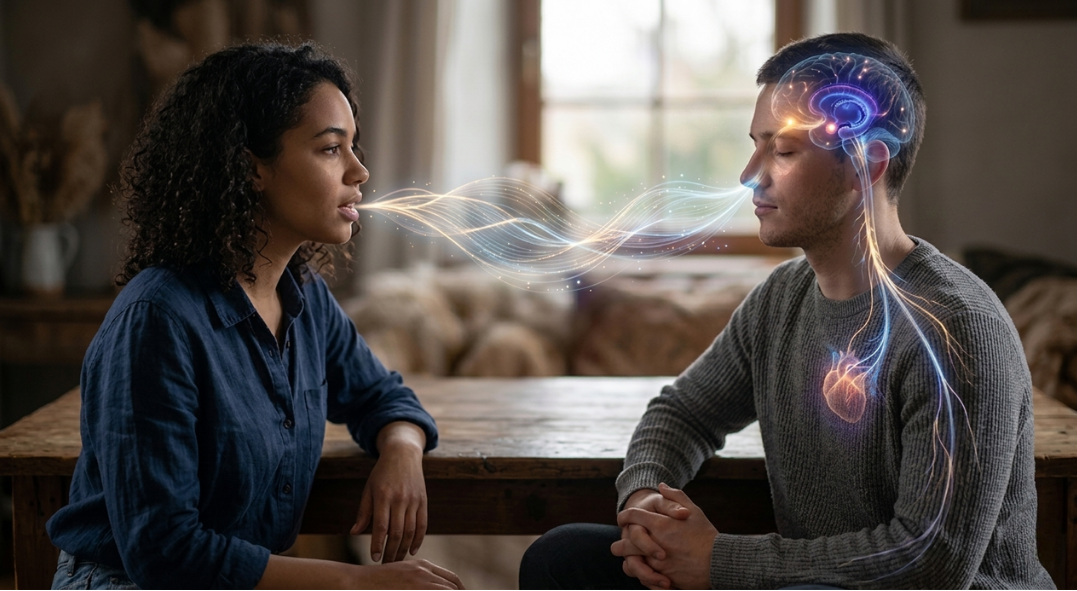
Then shift the question. Not just “what do you smell,” but “what do you feel.” That change alone opens access to responses that would otherwise be missed.
Where This Leads
This changes what you see. The breath at the beginning is clinical. The choice of a familiar oil is clinical. The question what do you feel is clinical. The silence that follows and what surfaces in it is data.
A person who has been told their olfactory nerve is damaged likely still has a trigeminal system responding. Still has memory circuits that activate. Still has pathways that respond when attention is directed inward. These pathways are still working. A multi-path approach is how to reach them.
This is a hypothesis at the beginning of its research life. The individual mechanisms are established. Their integration as a clinical approach is the territory ahead.
What is already clear is that smell loss is widespread, and the people living with it need an approach that works with everything their nervous system can still do. Essential oils, used with this level of intention, are positioned to do exactly that.
Selected References
Hummel T, Rissom K, Reden J, Hähner A, Weidenbecher M, Hüttenbrink KB. Effects of olfactory training in patients with olfactory loss. Laryngoscope. 2009.
Sorokowska A, Drechsler E, Karwowski M, Hummel T. Effects of olfactory training: a meta-analysis. Rhinology. 2017.
Zelano C, Jiang H, Zhou G, et al. Nasal respiration entrains human limbic oscillations and modulates cognitive function. J Neurosci. 2016.
Zelano C, Montag J, Khan R, Sobel N. A specialized odor memory buffer in primary olfactory cortex. Neuron. 2011.
Pierzchajlo S, et al. Olfactory perception and predictive processing. Nat Commun. 2024.
Doty RL, Mishra A. Olfaction and its alteration by nasal obstruction, rhinitis, and rhinosinusitis. Laryngoscope. 2001.
Wang X, et al. The role of the anterior insular cortex in interoceptive attention. Brain Struct Funct. 2019.
Sugawara SK, et al. Interoceptive training and neural plasticity. Neuroscience. 2024.
Raz A, et al. Suggestion and top-down modulation of perception. Neurosci Biobehav Rev. 2017.
Landry M, Lifshitz M, Raz A. Brain correlates of hypnosis and suggestion. Neurosci Biobehav Rev. 2021.