

What Lavender Can Do: Aromatherapy, Suggestion & Science
Lavender is relaxing. Except when it isn't. That seems like a contradiction. It is. It's a working contradiction.
Some studies support lavender for anxiety, sleep, pain, and stress. In others, it performs no differently from the control. Research on topical lavender points to effects smell can't account for. And research on odor perception shows that what someone is told about an aroma can change how they experience it.
These contradictions tell us something important about how essential oils function. They give us a wider framework to work within. Lavender and other oils are malleable.
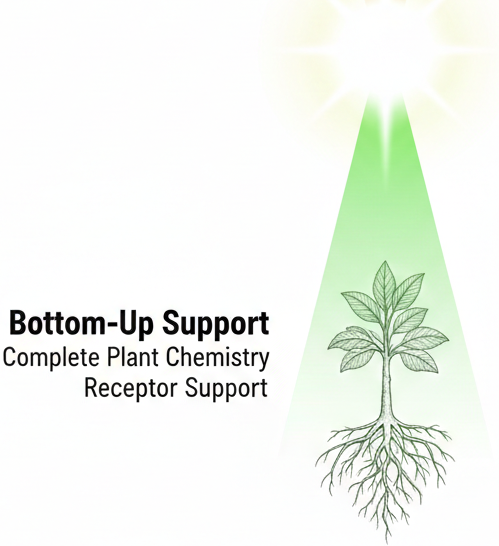
Information begins with something outside of us and works its way into our physiological and sensory experience.
From the Bottom Up
Lavender is one of the most researched essential oils. Chemistry is an obvious place to begin. Linalool and linalyl acetate are major constituents. Linalool in particular has been investigated for effects involving the nervous system. Clinical research with lavender has looked at anxiety, sleep, pain, stress, and other outcomes. The quality of that evidence varies. Research on an isolated constituent isn't automatically evidence for the same effect from using the whole lavender essential oil. Those results can still inform how we use the whole oil.
This is what we can describe as bottom-up signaling. Information begins with something outside of us and works its way into our physiological and sensory experience. Molecules interact with sensory receptors and, depending on the mode of application, potentially with other biological systems. Bottom-up is the usual way we approach an essential oil. It answers the question, what does it do?
Lavender gives us several examples of bottom-up activity. Laboratory studies show direct antibacterial and antifungal effects. Research also suggests activity related to wound healing and tissue repair. Human studies have reported analgesic effects and physiological changes after inhalation. The evidence gets more interesting from a top-down perspective.
The Verbal Experience of Lavender
I can give you lavender and tell you that it is deeply relaxing. I can give someone else the same lavender and tell them it’s stimulating. The response can shift in the direction of the instruction. The oil hasn't changed. I changed the information surrounding it.

Expectation, previous experience, memory, learning, language, and context are now influencing the sensory experience.
Research into odor perception has demonstrated that verbal information and expectation can influence how an odor is perceived. The same odor can be rated differently depending on what people have been told about it. In some experiments the influence extends beyond whether someone simply says they like or dislike the smell. This is top-down signaling. The brain influences how incoming sensory information is experienced. Expectation, previous experience, memory, learning, language, and context are now influencing the sensory experience.
When a therapist introduces lavender as relaxing, the treatment has begun before the client smells it. Information has already been provided about what the client is about to experience. The message has become part of the experience of lavender.
That doesn't mean the response is "all in your head." This isn't diminishing any of the known therapeutic effects of lavender. There are several processes occurring at the same time. With verbal cues, the chemistry is still there. Linalool doesn’t stop having biological activity because expectation is involved. Both can contribute to the response.
Lavender Is Malleable
In that sense, essential oils are malleable. I’m not saying we change the chemistry by talking about it. We can influence the experience and meaning attached to the aroma. We can also intentionally create new associations. If an aroma is repeatedly paired with a particular experience or physiological state, that aroma can become a cue associated with it. We are no longer waiting for lavender to tell the nervous system what to do. We are participating in the message.
The Bottom-Up and Top-Down Synergy
This is where my Holistic Essential Oil Triad becomes useful. I look at the chemistry of the essential oil, the olfactory experience, and the metaphysical influence. Chemistry gives us biological possibilities. Smell involves memory, emotion, learning, expectation, and association. The metaphysical allows for spiritual and energetic influences that may also be part of the experience.
And then there is the person. They bring their history, preferences, physical and emotional state, and previous relationship with the aroma. This is where all three parts of the Triad contribute to a holistic result.
This is how the bottom-up and top-down signaling converge. They are parts of the same therapeutic experience. This is why I keep coming back to a principle that guides how I use essential oils. The oils aren't chosen for a symptom. They are chosen for the person with the symptom.
Biophilia and Lavender

Exposure to plants and natural environments suggests that contact with nature itself can influence stress, mood, attention, and aspects of physiological state.
We have become very good at putting nature into little amber bottles. We identify the constituents, measure percentages, look at mechanisms, and try to determine which molecule is responsible for which effect. All of that is useful. Now stand beside a lavender plant. Walk through a field of lavender. You’re having a different experience. You see the color and movement, feel the air and temperature, listen to the environment around you, touch the plant, and smell the volatile compounds being released into the air.
This is where biophilia adds another layer. Research into exposure to plants and natural environments suggests that contact with nature itself can influence stress, mood, attention, and aspects of physiological state. I don't need to attribute all of that to lavender to recognize that our relationship with an aromatic plant can extend beyond the chemistry of its essential oil.
What Can Lavender Do?
The evidence doesn't give us one neat answer. I don't think we should try to manufacture one. Lavender has chemistry with biological activity. It has an aroma that interacts with memory, expectation, learning, and previous experience. It can be used through different modes of application. It comes from a living plant that can be experienced as part of nature. Sometimes when we use lavender, the result is disappointing. And sometimes it exceeds what we expected. That’s the working contradiction.
What lavender can do depends on what we do with it.
References
Cavanagh, H. M. A., & Wilkinson, J. M. (2002). Biological activities of lavender essential oil. Phytotherapy Research, 16(4), 301–308.
Donelli, D., Antonelli, M., Bellinazzi, C., Gensini, G. F., & Firenzuoli, F. (2019). Effects of lavender on anxiety: A systematic review and meta-analysis. Phytomedicine, 65, 153099.
Hansen, M. M., Jones, R., & Tocchini, K. (2017). Shinrin-yoku (forest bathing) and nature therapy: A state-of-the-art review. International Journal of Environmental Research and Public Health, 14(8), 851.
Harada, H., Kashiwadani, H., Kanmura, Y., & Kuwaki, T. (2018). Linalool odor-induced anxiolytic effects in mice. Frontiers in Behavioral Neuroscience, 12, 241.
Herz, R. S., & von Clef, J. (2001). The influence of verbal labeling on the perception of odors: Evidence for olfactory illusions? Perception, 30(3), 381–391.
Howard, S., & Hughes, B. M. (2008). Expectancies, not aroma, explain impact of lavender aromatherapy on psychophysiological indices of relaxation in young healthy women. British Journal of Health Psychology, 13(4), 603–617.
Kiecolt-Glaser, J. K., Graham, J. E., Malarkey, W. B., Porter, K., Lemeshow, S., & Glaser, R. (2008). Olfactory influences on mood and autonomic, endocrine, and immune function. Psychoneuroendocrinology, 33(3), 328–339.
Koulivand, P. H., Khaleghi Ghadiri, M., & Gorji, A. (2013). Lavender and the nervous system. Evidence-Based Complementary and Alternative Medicine, 2013, 681304.
Lillehei, A. S., Halcón, L. L., Savik, K., & Reis, R. (2015). Effect of inhaled lavender and sleep hygiene on self-reported sleep issues: A randomized controlled trial. Journal of Alternative and Complementary Medicine, 21(7), 430–438.
Masaoka, Y., Sugiyama, H., Katayama, A., Kashiwagi, M., & Homma, I. (2013). Analgesia is enhanced by providing information regarding good outcomes associated with an odor: Placebo effects in aromatherapy? Evidence-Based Complementary and Alternative Medicine, 2013, 921802.
Mori, H.-M., Kawanami, H., Kawahata, H., & Aoki, M. (2016). Wound healing potential of lavender oil by acceleration of granulation and wound contraction through induction of TGF-β in a rat model. BMC Complementary and Alternative Medicine, 16, 144.
Seifi, Z., Beikmoradi, A., Oshvandi, K., Poorolajal, J., Araghchian, M., & Safiaryan, R. (2014). The effect of lavender essential oil on anxiety level in patients undergoing coronary artery bypass graft surgery: A double-blinded randomized clinical trial. Iranian Journal of Nursing and Midwifery Research, 19(6), 574–580.